


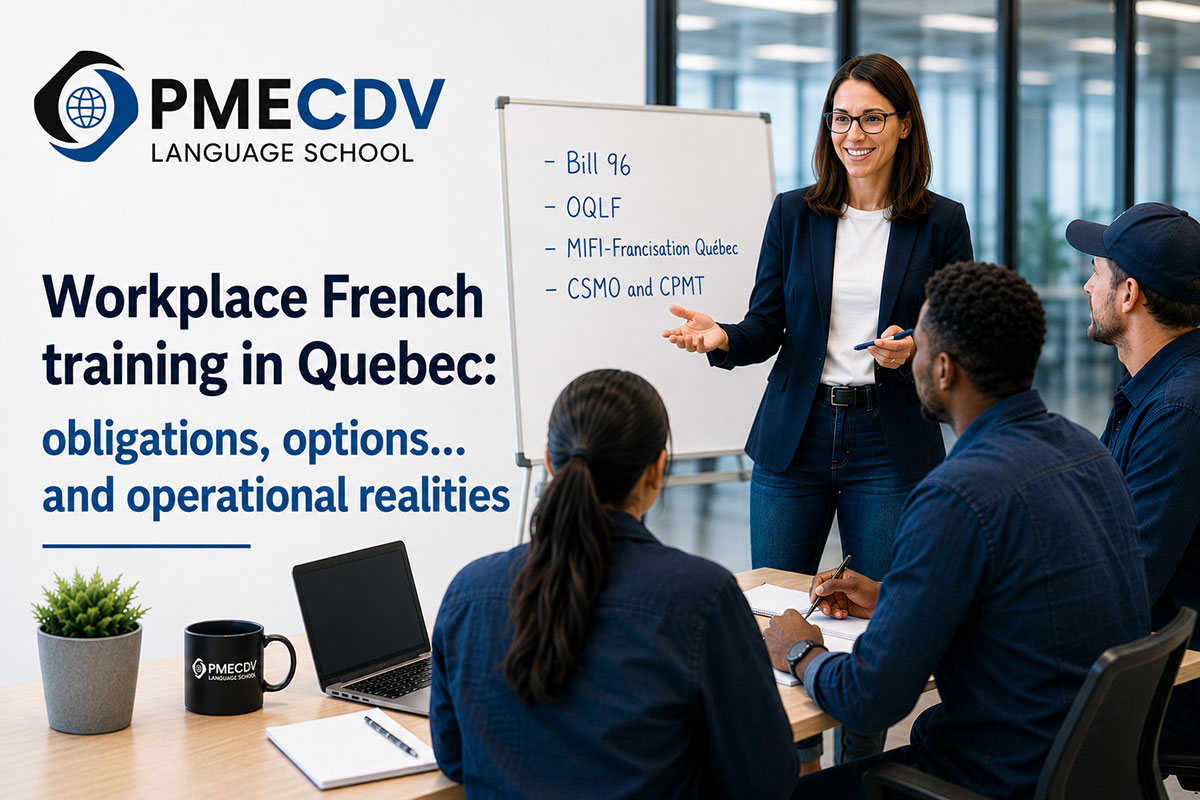
Since the adoption of Bill 96 and the recent reforms introduced by the Ministry of Immigration, Francization and Integration (MIFI), the issue of French-language training for non-French-speaking workers is no longer simply an integration matter — it has now become a strategic obligation for Quebec employers.
For many businesses, particularly in the agricultural, manufacturing, and service sectors, this raises a very practical question: how can employers provide effective, compliant language training that is also adapted to operational realities?
A Rapidly Evolving Regulatory Environment
Bill 96 reinforces the use of French as the language of work in Quebec. At the same time, immigration policies are evolving, as stricter language requirements are now tied to the renewal of certain temporary work permits (oral level 4). In addition, oral French level 7 is becoming a determining factor for obtaining permanent residency.
In concrete terms, this means workers must achieve functional levels of French proficiency, and employers have every interest in anticipating these requirements to avoid seeing employees lose their eligibility. French-language training therefore becomes both a retention and compliance strategy.
Free Solutions Exist… But They Come With Constraints
The good news is that Quebec offers several funded francization programs, notably through Francisation Québec and certain sector-based workforce committees (CSMOs), with programs supported by the CPMT (Commission des partenaires du marché du travail).
These initiatives provide access to free or highly subsidized training. However, in practice, many employers notice a gap between these programs and their actual operational needs.
Common Limitations of Subsidized Programs
Although these programs are valuable, they often come with significant constraints:
- Minimum group size requirements, which can be difficult for SMEs with only a few non-French-speaking workers
- The obligation to pay employees during training hours, directly impacting operational costs
- Courses that must take place during work hours, offering limited flexibility for businesses with non-standard schedules
- Multi-company remote groups on Teams, which are often less suited to the realities of a specific workplace
- Fixed schedules that may conflict with production peaks or agricultural seasons
As a result, many employers postpone or abandon francization efforts despite their strategic importance.
A Flexible Alternative: Customized Workplace Francization
Faced with these limitations, more and more companies are choosing a different approach: investing directly in training tailored to their operational reality. This is where specialized language schools such as PMECDV Langues come in.
Why Choose a Customized Approach?
Tailored francization training makes it possible to:
- Create groups based on your actual workforce size
- Adapt schedules (daytime, evenings, weekends)
- Target vocabulary specific to your industry
- Integrate training into your company culture
- Accelerate practical, measurable workplace results
Unlike standardized programs, this approach has one clear objective: making your workers functional in French within their real work environment.
PMECDV Langues: Recognized Expertise Since 2020
Since 2020, PMECDV Langues has been supporting Quebec businesses in the francization of their teams. Our approach stands out through a practical, field-oriented methodology, organizational flexibility, a strong understanding of employer challenges, and measurable results in communication and integration.
Compliance, Retention, and Performance
Francization is no longer optional. It is now an issue of compliance, retention, and organizational performance. Public programs provide an interesting starting point, but they do not always meet the operational constraints businesses face. In this context, a complementary, more flexible, and targeted approach can make all the difference.
Looking to Evaluate Your Options?
Whether you are considering a subsidized solution or a customized approach, it is essential to choose a model adapted to your operational reality. Contact PMECDV Langues to discuss your francization needs and identify the best strategy for your business.